
Your engineer opens the top-level assembly and gets a column of missing-file warnings. Twenty of them. The parts are still on the network somewhere. The assembly just cannot find them anymore, because a sync client moved a folder overnight to save disk space and did not think to ask.
That is machine shop cloud storage going wrong, and it never happens on a slow week.
Most shops have the other version of this problem too. A customer wants a price on a part you ran two years ago, and there are three copies of that print: one in an engineer's personal OneDrive, one in a folder nobody has cleaned out since 2019, and one on the server humming in the corner of the office. Nobody can say which revision actually shipped.
Nobody did anything wrong. Files pile up faster than anyone can sort them, and that is what sends a shop shopping for storage in the first place. But cloud storage for machine shops is a different job than cloud storage for an insurance office. Your files are big, they point at each other, and the floor stops when they are not where they should be.
There is a security argument for moving, and it is a fair one. Verizon's 2025 Data Breach Investigations Report found ransomware involved in 88% of breaches at small and mid-sized businesses, against 39% at large organizations. A well-run cloud platform is usually more secure than a server nobody has patched since the last guy left. But the cloud is not a security control by itself. What protects your prints is how the account gets set up, who holds the keys, and what happens the morning somebody opens the wrong invoice.
Here is the plain-English version we walk through with owners around Parkesburg and across Chester and Lancaster County, including the parts most articles skip. If you want the wider view first, we covered what the cloud actually buys a small business in an earlier post.
Machine Shop Cloud Storage Is Really Three Different Jobs
Most of the confusion here comes from one word covering three jobs that are priced, built, and used differently.
Sync and share
Microsoft 365 (OneDrive and SharePoint), Google Drive, Dropbox. Files live in the provider's data center and copies sync down to laptops and desktops. Great for sending a PDF to a customer. Complicated for large CAD assemblies.
A cloud file server
A server you rent instead of own, with a mapped drive that behaves like the box in your office. A cloud file server is often the right answer for older software that demands a drive letter. It also depends more on your internet connection than anything else on this list, so a shop with a weak upload will feel every second of it.
Cloud backup
Copies kept specifically so you can get files back, held separately from your working files, with real version history going back months instead of days.
Most shops need two of these three. The expensive mistake is buying one and assuming it covers all three jobs.
Start With What Your Shop Actually Stores
Before you price anything, spend twenty minutes listing what you keep and how it gets used:
- CAD and CAM files. SolidWorks, Mastercam, Fusion 360, Inventor, AutoCAD. Large, and they reference other files.
- Prints and PDFs the floor pulls up daily, plus scanned redlines and marked-up drawings.
- Travelers, routers, first-article reports, and cert paperwork you may have to produce for a customer three years from now.
- Quotes, POs, and the shared Excel workbooks that somehow run half the office.
- Your ERP data (JobBOSS, E2, Global Shop, Epicor, whatever you live in).
- Photos and video from the floor. Nobody counts these, and they quietly eat more space than the CAD files do.
Then answer three questions: how much data do you have in total, how much of it is active versus archive, and how fast did it grow last year. A shop that added 400 GB last year is going to add at least that again.
One rule worth writing down: a live ERP database does not belong in a sync folder. A database that is open and being written to all day will fight with a sync client, and you can end up with a copy that is corrupt in the cloud and on your server at once. Ask your ERP vendor how they want it hosted and backed up, then follow that answer instead of improvising.
The CAD Trap: Why Sync Folders and SolidWorks Fight
This is the part the generic articles never mention, and it is the part that costs shops real production time. CAD file storage has different rules than storing quotes and scanned POs.
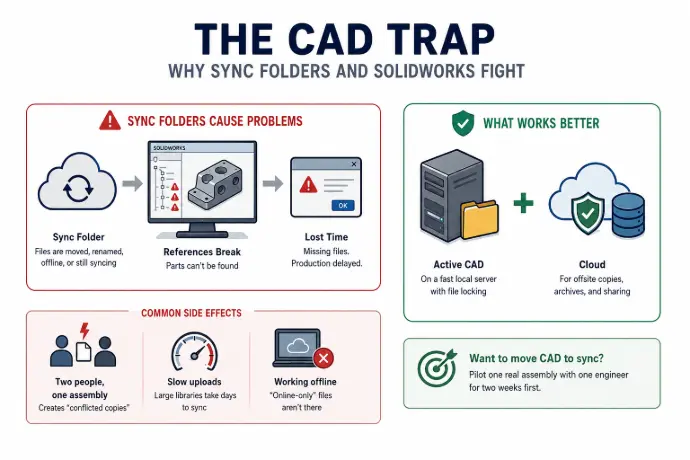
CAD assemblies reference their parts by file path. When a sync client moves a file, renames it, holds it "online only" to free up disk space, or simply has not finished syncing when the engineer opens the top-level assembly, those references break. What the engineer sees is a stack of missing-file dialogs and an assembly full of holes. What you see is an afternoon gone.
A few more ways CAD file storage goes sideways in a shop:
- Two people, one assembly. Consumer-grade sync tools resolve that by creating a "conflicted copy," so now there are two versions of the truth and no way to tell which one got machined.
- Upload speed. A 40 GB library over a typical shop's upload connection is a multi-day first sync, and every large revision after that competes with everything else on your internet connection.
- Working offline. The laptop that goes to a customer site with files marked online-only has no files at all in the parking lot.
What works better: keep active CAD on a fast local file server or on a service that does true file locking, and use the cloud for offsite copies, finished-job archives, and sharing with customers. If you do want to move CAD onto a sync platform, pilot it with one real assembly and one real engineer for two weeks before you move the whole library. We build managed IT plans built around a shop's file server precisely because this is where shops get hurt, and because CAD and CAM traffic behaves nothing like an office full of spreadsheets.
What Machine Shop Cloud Storage Actually Costs
The sticker price is per user, per month. The real cost includes several things nobody quotes:
- Seat creep. Every new office hire adds a license. Ten dollars a month per person is fine until you add up five years and eight people.
- Getting data back out. Cheap archive tiers often charge retrieval or transfer fees. Ask what it costs to pull 500 GB back down in a hurry, because the day you need it is the day you are already having a bad week.
- Bandwidth. You may need a faster upload connection to make this work, and that is a monthly line item too.
- Migration labor. Somebody has to move the files, fix the shortcuts, and remap the drives without stopping quoting for a week.
- The old server. It does not evaporate. Either it stays and gets maintained, or it gets retired properly.
On pay-as-you-go versus a fixed plan: fixed wins for most shops. Usage-based pricing only pays off if your storage rises and falls, and in manufacturing it almost never falls.
Questions to Ask Before Your Prints Leave the Building
Ask these of any provider, or of whoever is setting this up for you:
- Who owns the account? If your CAD library lives in an engineer's personal Dropbox or a Gmail account, you are renting access to your own prints. The subscription belongs in the company's name, with the owner holding admin access.
- Is multi-factor authentication turned on for everyone? Including the owner, and including the office manager who "just does invoices."
- Can you set permissions by folder? Shipping does not need write access to engineering.
- How far back does version history go, and can you roll a whole folder back? Thirty days is common. Thirty days is not much when a folder gets quietly encrypted or deleted.
- Are there audit logs? When 4,000 files vanish on a Friday night, you want to know which account did it.
- What happens when somebody leaves? There should be a documented process for pulling their access and keeping their files, run the same week they hand in their badge.
Cloud Backup for Manufacturers Is a Separate Purchase
This is the single most expensive misunderstanding in the whole topic, so it gets its own heading.
Sync is a mirror. It faithfully copies whatever happens, including the bad things. Delete a folder on a laptop and it deletes in the cloud, then on every other machine. Get hit with ransomware on a synced or mapped folder and the encrypted versions ride right up to the provider. Version history buys you a window, usually about thirty days, which is plenty for "I overwrote the wrong quote" and useless for "that archive folder has been gone since spring."
A backup is separate. CISA tells small businesses to keep a combination of on-site and offline copies, encrypt them, and run scheduled recovery tests rather than assuming the job that says "successful" would actually give you your files back. That is the whole difference between cloud backup for manufacturers and a sync subscription: separation, retention, and a restore somebody has proven.
Then the part everybody skips. Pull back a job folder from last quarter and time it. If nobody has ever restored anything, you do not have a real backup and recovery plan, you have a subscription and a hope.
Five Ways Shops Get This Wrong
- Buying on price alone. The cheapest plan often means no real support, slow retrieval, and fees on the way out.
- Letting personal accounts become shop storage. It starts as one engineer being helpful and ends with your prints tied to somebody's private login.
- Skipping the integration check. Confirm it plays nicely with what you already run: Microsoft 365 or Google Workspace, QuickBooks, your CAD seats, your ERP's document handling.
- Assuming sync equals backup. See above. This one takes shops down for days, not hours.
- Never checking upload speed. Everything about cloud storage for machine shops comes back to how fast you can push data out of the building.
What This Buys You at Renewal Time
Set this up properly and you get something you did not pay for. Your cyber insurance application asks whether multi-factor authentication is enforced, whether backups are offsite, whether access is controlled by role, and how quickly you could recover. A well-configured storage and backup setup answers several of those with a straight yes instead of a maybe.
The same answers show up when a Tier-1 customer sends a vendor security questionnaire and expects it back in a week. We put together the documentation that goes with all of this, so it becomes paperwork you hand to your broker or your customer instead of a fire drill, and so one resignation cannot take the answers with it. If renewal season is close, here is what cyber insurance carriers are asking manufacturers for now.
Machine Shop Cloud Storage FAQs
Is OneDrive a backup?
No. OneDrive, Google Drive, and Dropbox are sync tools, which means they copy whatever you do, including deleting a folder or encrypting it with ransomware. Version history usually runs about 30 days. A backup keeps separate copies you can restore from months later, stored where a compromised account cannot reach them.
Can we run SolidWorks assemblies out of a cloud sync folder?
Usually not well. Assemblies reference their parts by file path, and sync clients move, rename, and hold files online only in ways that break those references. Two people opening the same assembly can also produce conflicted copies. Keep active CAD on a fast local file server or a service with true file locking, and use the cloud for offsite copies and archives.
How much cloud storage does a small machine shop need?
Most shops running 5 to 25 computers land between 1 and 5 TB once CAD history, scanned prints, quality records, and floor photos are counted. Growth matters more than the starting number. Check what you added over the last 12 months and budget for at least that much again next year, because CAD libraries and job photos rarely shrink.
How long does it take to move a shop's files to the cloud?
Plan on two to six weeks from decision to done for a shop with 5 to 25 computers. The first upload is the long pole: 500 GB over a 20 Mbps upload connection runs roughly three days of continuous transfer, and most shops cannot hand it the whole pipe during production hours.
Should we get rid of our file server?
Not automatically. A local server still wins for large CAD assemblies and for software that expects a mapped drive letter, because a gigabit local network beats most shop internet connections. Many shops keep a cloud file server or an on-site box for working files and use the cloud for sharing, offsite copies, and archives. Decide by file size, upload speed, and what your software requires.
Does cloud storage help with cyber insurance?
It can, if it is set up the way carriers expect. Applications ask about multi-factor authentication, offsite copies, access controls, and how fast you could recover. Cloud storage on its own answers none of those. Cloud storage with MFA enforced, permissions by department, and a separate tested backup answers several of them.
Not Sure Where Your Shop's Files Actually Live?
Starlux IT is in Parkesburg, and we look after small manufacturers in Coatesville, Downingtown, Gap, and across Chester and Lancaster County. We spend our days in shops that run SolidWorks and Mastercam off a file server, so we know the difference between storage that looks fine on paper and storage that survives a Monday morning with two jobs already late. We also document what we set up, so one resignation cannot freeze your shop.
If you are not sure whether your files are backed up, who can reach them, or what would actually happen if the server died tonight, we will spend 30 minutes on it with you. No pressure and no pitch deck. We'll check what you have, show you the gaps, and you'll know exactly where you stand, whether you hire us or not.